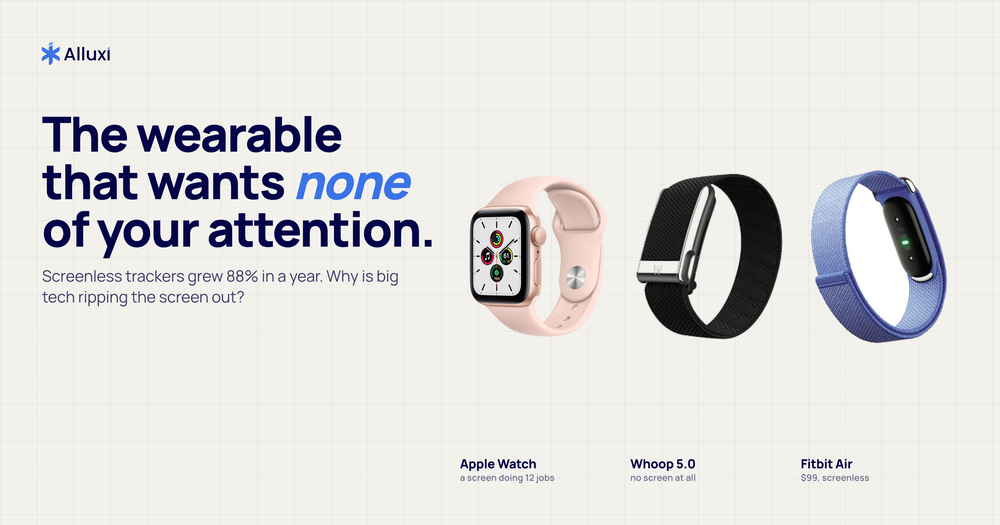
The wearable that wants none of your attention
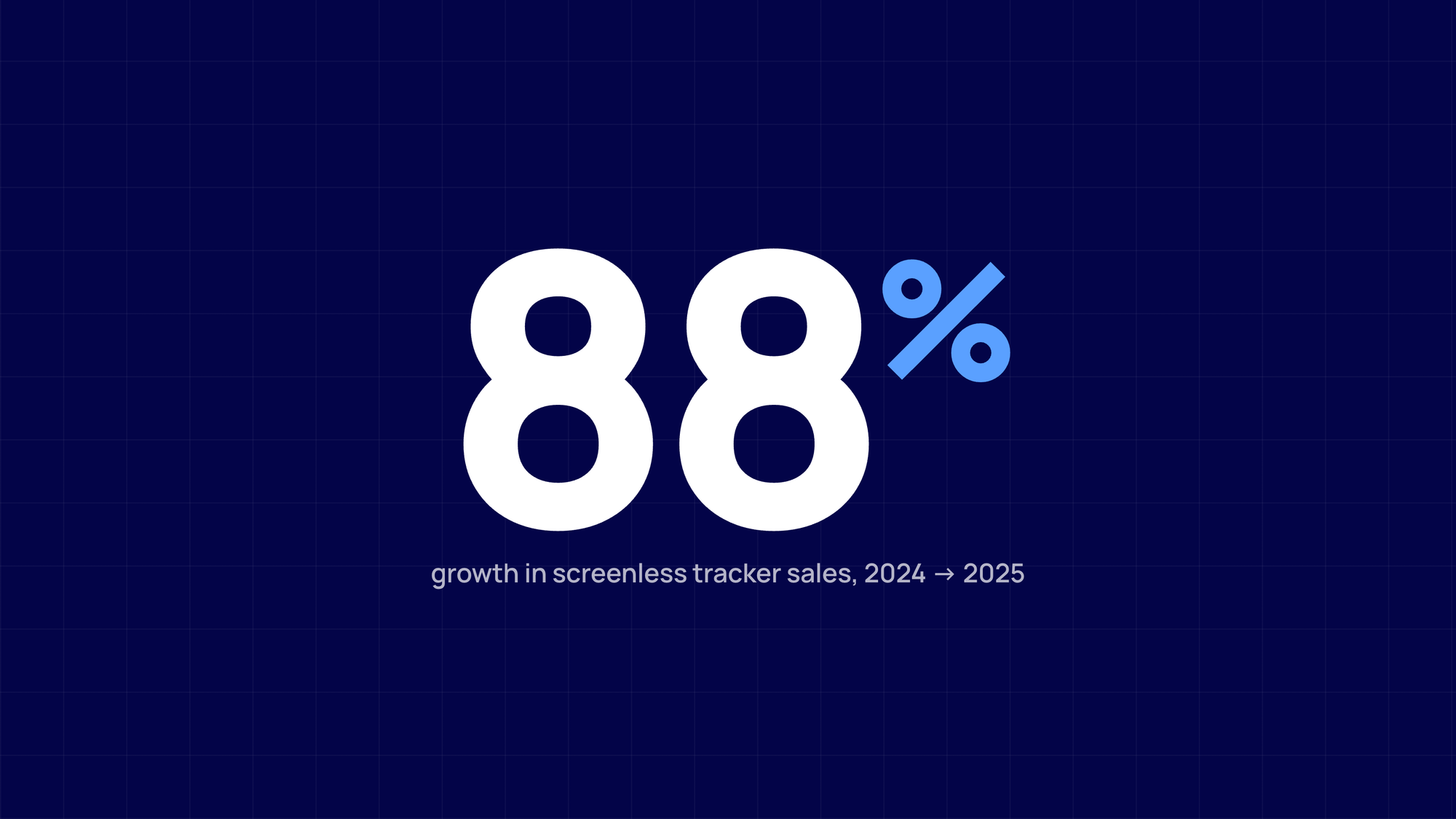
Screenless fitness trackers have seen sales grow by 88% since 2024. Last month, Google joined in with the Fitbit Air: a $99 pebble, no screen, clipped into a fabric loop, made to be worn 24/7 and forgotten about.
Ten years ago, the whole pitch was the screen. The face you tapped. The rings you closed. That little dopamine buzz at 10,000 steps. Now, the biggest device brands on the market have ripped out the one thing that made a wearable a wearable.
That's a strange direction for a whole industry to turn. Worth understanding before you buy your fourth health gadget.
The screen retreat
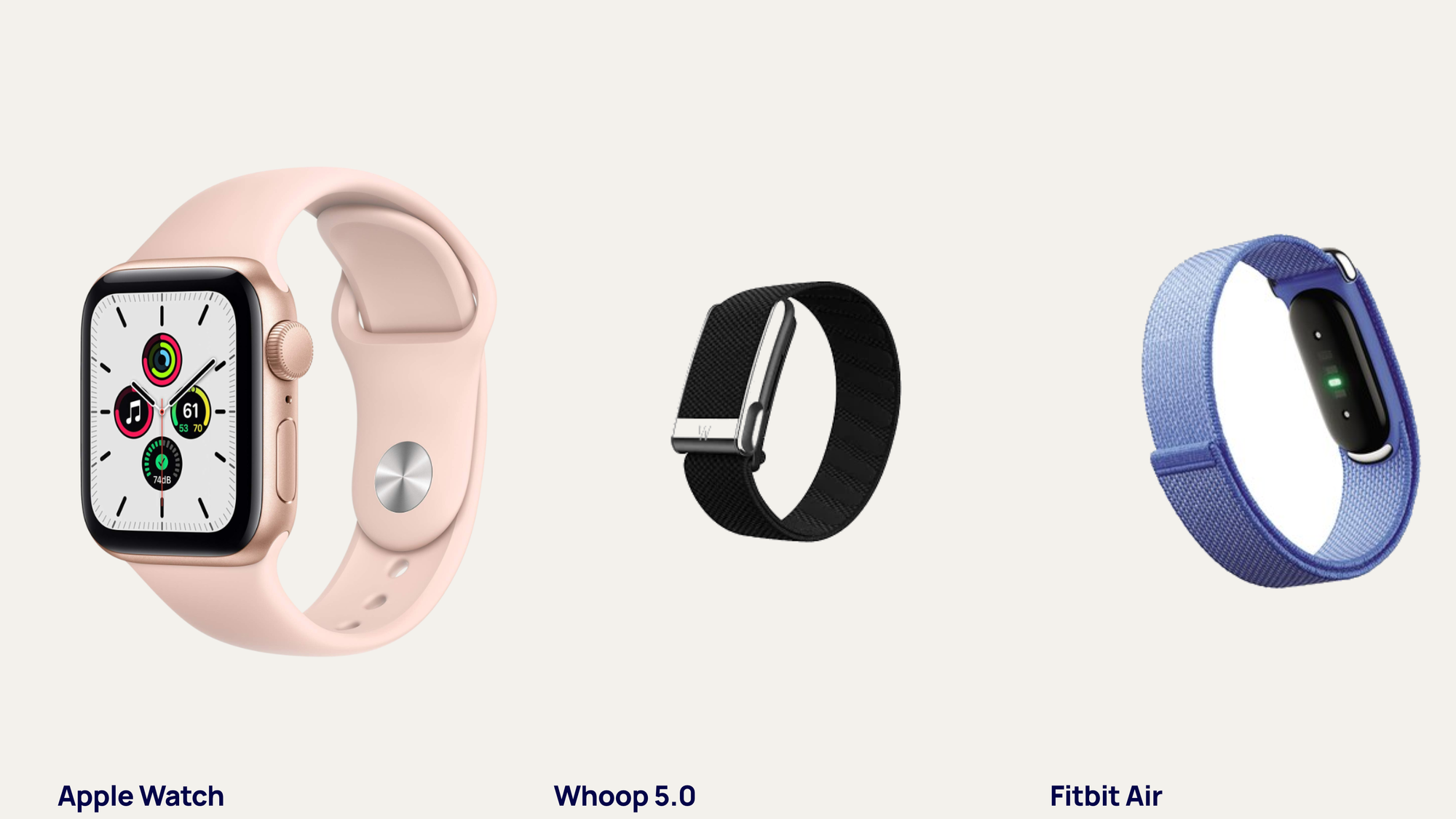
The Apple Watch is the maximalist. A wrist computer that also tracks your heart. It pings you, shows you texts, tells you to stand, wash your hands, etc. Around 80% of iPhone owners who buy a smartwatch buy an Apple Watch, so for most people, this is what "wearable" means. A tiny screen doing a dozen jobs.
The Whoop is the totally opposite bet. No screen at all. You buy the band ($199 for the 5.0, a year of membership ), and it quietly logs heart rate, sleep, strain, recovery, even an on-demand ECG now. Then it feeds it all to an app you can open whenever you feel like it. The device is supposed to vanish. Only the insight reaches you. One guy who's worn his for over 1,800 days says he checks in with his body before he checks in with the cloud, and that the band lowered his anxiety because nothing buzzes at him. It just sits there, watching.
The Fitbit Air is Google copying that homework for everyone else. Screenless, $99, a week of battery, heart rate, SpO2, sleep stages, AFib alerts, plus a Google Health Coach app to do the nudging. The message is not subtle. Google looked at Whoop and Oura, saw screenless sales jump 88% in a year, and bet that the everyday tracker of the future is a sensor you never look at.
Funny place to end up. We started with wearables that begged for your attention. The smart money now builds wearables that want none of it.
The anxiety
About a third of Americans track their sleep with a device. That's been going on long enough to grow its own disorder. It has a name. Orthosomnia. An obsession with hitting a perfect sleep score, bad enough that it wrecks the sleep it was meant to fix.
You wake up. You check the number. The number says you slept badly. Now you're anxious about being tired, which is a great way to make sure you stay tired.
A health journalist who ran marathons wrote about getting hooked on her resting heart rate. Smug under 50 beats a minute. Panicking over 60. She quit tracking completely, called it freeing, and stayed away for years. Her take on the Whoop 5.0: if you're serious about this, it has everything you could want, and for most people, that's exactly the problem. Too much information.
Strip out the hype, and the research lands somewhere not-so-nice. For inactive people, a tracker does get them moving and does improve their fitness. If you're on the couch and a step count gets you to walk, the thing has paid for itself. But the studies keep circling around the same conclusions: recording a number is not the same as changing a habit, and there's thin evidence that trackers drive lasting change on their own.
So the marketing has it backward. The Whoop MG with its medical-grade ECG, the Fitbit Air with its AFib alerts, all aimed at the health-obsessed.
The people who'd gain the most are the ones who'd never think to strap one on. The customer and the ideal user are rarely the same person.
The bed knows more than the wrist
The best move in this whole category isn't on a wrist. It's a mattress.
The Eight Sleep Pod is a cover that tracks your sleep stages, heart rate, HRV, and breathing, then does the thing no wristband can. It acts. While you're asleep, it shifts the bed's temperature between 55 and 110 degrees on each side as you move through the night, and lifts your head when it hears you snore. Its Autopilot was trained on nearly 10 million hours of sleep data. As of April, it hands you a plain-English brief in the morning telling you what happened.
Forget the price for a second (the Ultra runs into the thousands, and the subscription piles on another $1,000 to $2,000 over five years). Look at the design instead. A wristband measures and hands the problem straight back to you. Here's your bad score. Good luck. The Pod measures and quietly fixes the room while you're unconscious and unable to refresh a chart. It pulls you out of the optimization loop entirely. No score to stare at, no orthosomnia.
That's the real frontier. Not more sensors. Not prettier dashboards. Closing the loop, so the device does something with the reading instead of escalating it to your nervous system. A tracker that tells you you slept badly is a complaint. A bed that warms your feet so you sleep better is a fix. Most of the wrist market is still in the complaints business.
So, benefit or marketing?
Both. Depends entirely on who's wearing it.
Starting from the couch? Almost any of these helps, and the $99 Fitbit Air is a steal. An athlete who treats data as an input, not a verdict? The Whoop's depth earns its keep. Checking your score the second your eyes open, letting a strap decide whether your day is good or bad? That's not a fitness problem. It's a different problem, and a sharper sensor only feeds it.
The over-optimized health profile of 2026 is a creature in its own right. Recovery band on the wrist, AI mattress under the back, three apps cross-referenced before coffee. Some of those people are genuinely healthier. Some just bought an expensive new way to feel like they're failing. The hardware can't tell which is which, and the companies have no reason to ask.
The question was never which device is best. It's whether the number makes you do something or just makes you worry.
Do something, then it's a tool. Just watch it and stressa bout it, it's a mirror with a monthly fee.
Would you still wear yours if it never showed you a single score and only quietly changed something in the background?