
Systems Development Life Cycle (SDLC): The 7 Phases Explained with 2026 Examples
Software system development is a complex process. A recent survey indicates that many developers believe the expansion of AI and machine learning has significantly increased the complexity of software development projects over the past few years.
It highlights the need for a systematic development framework. That’s where the system Development Life Cycle (SDLC) methodology is useful.
It offers a well-structured framework for development teams to build, deliver, and maintain high-quality, cost-effective IT (information technology) systems. The SDLC consists of seven steps: Planning, Analysis, Design, Development, Testing, Implementation, and Maintenance.
These steps are critical in building a high-performance software or computer-based system. In this article, we will discuss all these steps, stages, or phases in detail. Our goal is to learn how SDLC can minimise risks and ensure the final system aligns with user needs or organisational objectives.
What is the System Development Life Cycle (SDLC)?
Project managers and system analysts simplify software development projects using the system development life cycle (SDLC). It includes structured, measurable, and iterative steps, each with its own objectives and deliverables. The primary purpose of SDLC is to ensure the successful development of a computer-based system that meets stakeholder needs. It also works effectively within the given IT framework or infrastructure.
The SDLC particularly focuses on complex and time-consuming software systems. For them, it offers a set of structured and well-defined steps to develop a new information technology system from scratch.
Here are the stages of SDLC that turn a software project from vision to reality:
- Planning
- Analysis
- Design
- Development
- Testing
- Implementation
- Maintenance
In the following section, we have discussed these stages in detail.
Phases of the System Development Life Cycle (SDLC)
The SDLC breaks down the entire software system development work into interconnected and repeatable phases. Let us discuss the key phases or stages that form the foundation of the system development life cycle model. The development teams are free to create and leverage more phases as per their choice based on their project needs.
1. Planning
The planning phase is also known as the feasibility phase. It is the first and most important phase of the SDLC. The development team starts brainstorming what needs to be built, why it is needed, and the correct approach to get it done, along with the more high-level project details.
The goal is to establish a clear understanding of the things that are required, can be excluded, and must be avoided. Everything from scheduling to resource allocation is carefully planned in this phase. Additionally, each team member's role is clearly defined to avoid confusion and delays.
An initial software requirement specification (SRS) document is prepared at the end to effectively communicate project requirements with the team and stakeholders at any time during the development. It includes software, hardware, functional, and network-related information to develop the system. The SRS document also includes the details about the software's functions and risks associated with the development.
2. Analysis
In this stage, a vast amount of data is collected from stakeholders, including customers, internal and external experts, and managers. It helps the team create a software system that meets customer expectations and organisational challenges. The idea here is to prepare a practical implementation plan backed by the market research and feasibility test data.
If there is any existing software, it is analysed thoroughly to understand the flaws and challenges faced by the end-users.
Based on all the data, a complete list of specific problems and requirements the new software is supposed to address is prepared for future reference.
3. Design
The developers create a detailed technical blueprint in the design stage. Such a blueprint represents the requirements gathered during the analysis stage. The team tries to gain insights into the best way to build the given software system. The blueprint includes the system's critical components, such as the database, user interface, system interface, navigation, and more.
One more crucial task in this stage is addressing cybersecurity concerns using threat modelling exercises.
The software design document (SDD) collects the entire design phase work. The blueprint or architecture is compared against the requirements mentioned in the SRS document. The team is supposed to turn the SRS document into a more logical structure that can be implemented in the next stages.
4. Development
Here comes the stage or phase of system development where the actual code is written. As such, this stage is also known as the coding stage. It brings the system development plan to life. The code is based on the requirements mentioned in the SDD and SRS documents. The developers must choose the most appropriate programming language to implement these requirements successfully.
If any additional interfaces or modules need to be built for the system's proper functioning, the developers must create them in this stage only—for example, the application programming interfaces (APIs).
5. Testing
The developers must follow coding standards and best practices for the system's proper functioning.
The testing phase ensures the system developed in the previous step is error-free and functional. The code should be clean, readable, and scalable. There are different types of testing. Here are the most popular ones:
- Unit Testing
- Integration Testing
- System Testing
- User Acceptance Testing
These tests enable developers to identify and eliminate bugs, ultimately improving the final product. If there are any security concerns, the team works on the final product until the issue is resolved.
Testing can be both automated and manual. The AI tools are designed to streamline most of the testing process. However, the testing phase is inherently time-consuming, mainly due to the complexity of the design.
6. Implementation
This phase deploys the developed and tested system into a live environment. The experts suggested that the project managers should thoroughly plan the system deployment because there are multiple complex steps involved:
- System Installation
- Data Migration
- End User Training
- Infrastructure Configuration
The goal is to integrate all modules and designs.
The development team writes code and performs tests on a different copy of the software, which is known as the build environment or testing environment. This copy differs from the one used by end-users and is known as the Production version.
Note that just deploying the system is not enough; project managers must ensure the end users can use the system as planned. He/she may deploy the finely tuned software system in different phases. For example, in the beta release, a limited group of people gets early access to the system. This way, the system analyst can analyse their system's performance in the real world.
It is necessary to make corrections to ensure a fully functional system that performs as per the user expectations before it reaches general availability (GA).
7. Maintaining
The SDLC doesn't end after the deployment. The final stage is maintenance. It is an ongoing stage or phase, including bug fixes, performance enhancements, security patches, and more.
Developers continuously monitor, update, and maintain the software system as needed. The goal is to keep the system running efficiently, staying secure, and flexible enough to handle future needs. That said, proper maintenance is the key to safeguarding the longevity of the software system.
The maintenance phase also includes phone or physical on-site support. All bugs identified and improvements suggested by end-users must be addressed promptly to enhance the existing software.
Benefits of System Development Life Cycle (SDLC)
System development is a huge task, including multiple aspects that require regular attention.
The successful completion, on-time delivery, meeting client expectations, excellent system quality, etc. are all dreams of every project manager. They can only be fulfilled if the project managers use a structured system development framework. That framework is called the system development life cycle (SDLC).
Here are the benefits of the SDLC framework:
- Structured Approach: The SDLC offers a step-by-step framework for system development. The developers will have a list of clearly defined goals and the compliance to follow. They start with a plan, which is then followed by the market analysis, design, development, testing, implementation, and maintenance. The main purpose of this framework is to outline a clear direction and ensure that nothing is skipped.
- Increased Productivity: The development team will have clear documentation in place right from the beginning of the project. It enables a clear view of the entire project to every team member. Additionally, such documents also eliminate the guesswork and drastically improve the productivity of the development teams.
- Risk Management: With a few SDLC models, project managers can identify and address errors in the development at the end of every phase. Minor problems are eliminated before they grow into bigger ones. Such a continuous risk assessment is critical to ensuring quick delivery.
- Excellent Collaboration: SDLC documentation defines specific deliverables for each team and its members. These roles and deliverables enable faster communication and better collaboration among developers, testers, and managers. They also encourage team members to participate in small, highly collaborative groups.
- Efficient Resource Allocation: The phases or stages of SDLC allow project managers to estimate and allocate time, cost, and resources more accurately. All of these play a critical role in the system's overall success. For example, from the beginning of project development, stakeholders are aware of the required resources and associated costs. This way, they can easily calculate the base cost and assign a reasonable budget. Such pre-planning drastically decreases bloat and keeps projects on track.
- Customer Satisfaction: The SDLC allows development teams to complete projects within scheduled time frames and cost estimates. It significantly improves customer satisfaction. The final system accurately matches the customer requirements and fits into an organization's existing IT infrastructure.
The system development life cycle framework accelerates problem-solving and enables greater risk management.
System Development Life Cycle vs. Software Development Life Cycle
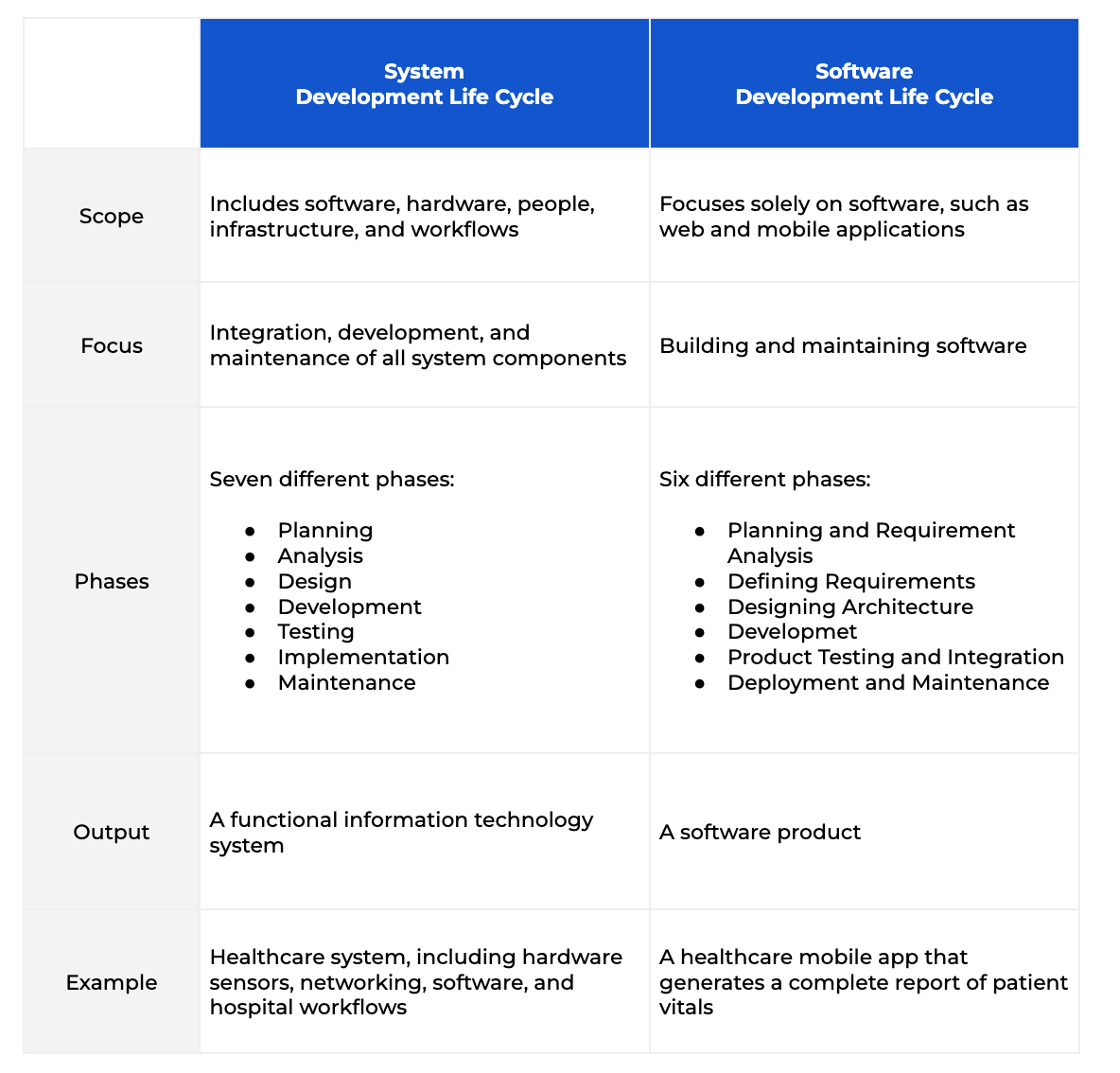
Both System Development Life Cycle and Software Development Life Cycle are used interchangeably. But note that they have entirely different meanings.
The term "system" in the system development life cycle includes both hardware and software. It is a broad framework with a wider scope. On the other hand, the software development life cycle only includes software development projects.
Here is the quick comparison table for better understanding:
System Development Life Cycle (SDLC) Models
There are a variety of SDLC models. The right choice depends upon various factors, including the project's complexity, the developer's skills and experience, etc.
1. Waterfall Model
It was one of the most popular SDLC models.
In this model, the next stage or phase starts after the previous stage or phase is finished. As such, this model is known as the linear or sequential system development model. Such a model is beneficial when the project is well-defined and stable.
Please take note that each phase in the waterfall model has separate plans that heavily depend upon the outcomes of the previous step. As a result, addressing shortcomings in earlier stages becomes increasingly challenging as we move forward in the waterfall model.
That's why this model is considered time-consuming and not flexible enough, which can lead to significant problems down the line.
2. V-Model
The V-model is similar to the waterfall model, except that each phase in this model has integrated testing to ensure verification and validation. You may call it an advanced version of the waterfall model.
With the frequent testing in the V-methodology, development teams ensure an error-free software system. They quickly catch potential bugs and defects before moving to the next phase. However, this model also follows a linear structure, making it less flexible than other modern SDLC models discussed below.
3. Iterative Model
In this model, development begins with a small subset of requirements, gradually expanding through repeated iterations until the software is production-ready.
The team produces a new software version at each iteration. The initial version is known as the minimum viable product (MVP). It helps the project manager easily identify and manage risks through each iteration.
An iterative model simplifies software development by initially letting developers focus on a small goal. They can then easily improve the product multiple times before it enters Production.
4. Spiral Model
It is the combination of the iterative and waterfall models.
In this model, a set of phases occurs in a repeating cycle to offer multiple opportunities for correction. These phases mainly focus on determining objectives, risk analysis, resource allocation, development, and testing. The spiral model focuses on letting development teams build multiple prototypes throughout the project life cycle and incorporate feedback relatively early and continuously.
This model is more flexible and valuable than the ones discussed earlier. However, it is beneficial mainly for large, complex projects requiring frequent corrections.
5. Big Bang Model
The big bang model is an excellent choice for small projects. Similar to the popular Big Bang theory, this model lets you start from nothing. It lacks a rigorous process or a structured format.
The model is considered informal and high-risk. It is useful only when the customer or client is unsure of their requirements and has no solid action plan.
6. Agile Model
It is one of the most used SDLC models.
The agile model allows teams to rapidly iterate through the phases by arranging all SDLC phases into several development cycles. All requirements, plans, and results are monitored and evaluated to ensure error-free software systems. Developers continuously deliver small, incremental changes in this phase.
The team prioritizes fast and ongoing release cycles while performing more tests than other models. Such rapid development cycles can identify issues before they become significant problems. This model is beneficial, particularly when the client can actively participate in frequent meetings and reviews.
7. Lean Model
This model applies the principles of manufacturing to system development. The goal is to reduce waste at every phase or stage of the system development life cycle.
The lean SDLC model helps project managers enhance business procedures. The model incorporates short-term goals, rapid iterations, and quicker feedback implementation to ensure the final system's best-in-class quality.
8. Rapid Application Development (RAD)
Like the agile model, this also focuses on quick and iterative release cycles. They are both types of incremental process models. The rapid application development model focuses on frequently collecting client requirements and early testing of the prototypes. It also allows the reuse of the existing prototypes for quicker delivery.
In this model, developers can use powerful and modern development tools for the successful and on-time delivery of the system. These tools allow teams to implement necessary changes to the system without impacting costs or delivery timelines.
Common Challenges in SDLC (System Development Life Cycle)
Due to the SDLC’s comprehensive nature or high complexity, they are prone to failures.
Here are the most common challenges that can threaten the successful implementation of system development life cycle (SDLC) projects.
- Changing Requirements: Most of the time, stakeholders initially fail to define their needs. As a result, project requirements may expand beyond control at any phase of SDLC. Such a changing requirement causes scope creep.
- Cost Overruns: This is one of the significant complications associated with the SDLC projects. No matter how much effort you put in, the initial budget estimation often misses hidden costs.
- Integration Challenges: Integration is one of the most difficult tasks in system development projects. The developers are supposed to combine hardware, software, and processes. The expert says that combining complex infrastructure components without conflict is tough.
- Relentless Drive for Perfection: In system development, being done often takes precedence over being perfect. That said, an endless pursuit of perfection can throw a project off track. Once testing confirms completion, developers should immediately proceed to the next phase. Experts believe in such an approach to speed output and cut costs.
- Security Risks: As the system's size increases, it becomes more susceptible to serious cyber attacks and vulnerabilities. The IBM X-Force Threat Intelligence report shows that attackers frequently target third-party vendors as a pathway to impact successful organizations. It highlights the need for high-tech measures to secure sensitive data and critical components of the client's organisation.
FAQs
Q. Is SDLC waterfall or agile?
These are both the system development life cycle (SDLC) models. The waterfall model was the most popular one back in the days to complete a SDLC project. But over the past few years, the agile methodology has been growing in popularity. It offers more flexibility and versatility compared to the traditional waterfall model.
We have discussed both of these methodologies in detail in the above section.
Q. What are the five original phases of the system development life cycle (SDLC)?
When the system development life cycle (SDLC) was first introduced, it consisted of five phases or stages instead of seven. Those five stages were planning, designing, development, testing, and deployment. The analysis and maintenance phases were later added to bring the framework to completion.
Q. Is DevOps an SDLC model?
No. DevOps is a software development approach. The SDLC, which stands for System Development Life Cycle, is a systematic management framework. DevOps helps project managers speed up the development of high-quality systems through collaboration and automation between the development and operations teams.
Q. Are SDLC and Scrum the same?
Scrum is an advanced model or methodology that manages complex system development life cycle (SDLC) projects.
It incorporates Scrum principles into SDLC for iterative development, collaboration, and adaptability through short release cycles known as scripts.
Q. Is SDLC a methodology?
Yes. The system development life cycle (SDLC) is a methodology based on a systematic management framework. It assigns specific deliverables to every development stage.
The SDLC methodology is based on seven different stages or phases: Planning, Analysis, Design, Development, Testing, Implementation, and Maintenance. To read more about the SDLC and its phases, refer to the above sections of this article.
Alluxi: Leading Nearshore System Development Company
Alluxi brings 10+ years of expertise in transforming million-dollar ideas into thriving digital businesses. Our mission is to empower companies to grow by delivering cost-effective, high-quality solutions through collaborative development.
Whether you're planning a small-scale project or an enterprise-grade information technology system, we can help bring your vision to life.
Here is a quick list of our highly reliable digital transformation and custom development services:
- Customer Experience Transformation
- Business Process Digitalization
- Software Modernisation
- Nearshore Software Development
- Custom Web and Mobile Application Development
- Healthcare System Development
- HR System Development
- Educational System Development
Get in Touch
We believe that every business is unique. That's why we take the time to understand the mission behind your business, why it's headed in that direction, and how we can help you get there.
Contact our team of experts to understand how we can accelerate your system development.
Email: [email protected]
Phone: +52-(812)-027-8245
- Custom software development service - how Alluxi runs the SDLC for client engagements.
- SDLC 2026 walkthrough: IBM model + agile model side by side - companion long-form piece with worked examples.
- 5 essential agile code practices for developers - applied agile in the implementation phase.
- Business process digitalization - how an SDLC supports digital transformation programs.
- Business process automation - sister framework that runs alongside the SDLC.